


Cetaceans are among the most mysterious creatures on Earth. Scientists still know relatively little about these highly intelligent animals. Whales spend most of their lives in the hidden depths of the ocean and surface only occasionally. Many people dream of catching a glimpse of these gentle giants in their natural habitat. Here’s what makes whales so fascinating — and which species you can encounter in Russia.
Where to See Whales in Russia
A guide to the best whale watching spots

Quick Navigation
What’s So Fascinating About Whales?
Classification of Whales
Whale-Watching Guidelines
A Brief History of Human–Whale Relations
Where to See Whales in Russia
When to Spot Whales
Can You Take Kids on Whale Trips
How to Photograph Whales
Whale-Watching Prep List: Books and Films
Whale-Watching Around the World
What’s So Fascinating About Whales?
Although whales look like fish, they are actually mammals and share all the key characteristics of this class. Whales are warm-blooded, able to maintain a constant body temperature regardless of the surrounding water. They breathe air through their lungs, give birth, and nurse their young with milk.
Cetaceans spend their entire lives in the ocean or rivers and never come onto land. However, about 50 million years ago, their four-legged ancestors — Pakicetus — lived on land and approached the water only in search of food or to hide from larger predators along swampy, overgrown shores. These ancient creatures looked like a cross between a crocodile and a dog, yet were actually related to hoofed mammals.
Over millions of years of evolution, cetaceans became the most fully aquatic of all marine mammals, adapting perfectly to life in the water:
— Their hind limbs disappeared, and their forelimbs transformed into flippers.
— They developed a powerful tail for swimming.
— They lost their fur to reduce drag and developed a thick layer of insulating blubber instead.
— Their nostrils shifted to the top of the head for easier breathing.
— Their external ears disappeared, leaving only small openings.
— Even their internal organs and physiological processes underwent significant changes to suit underwater life.
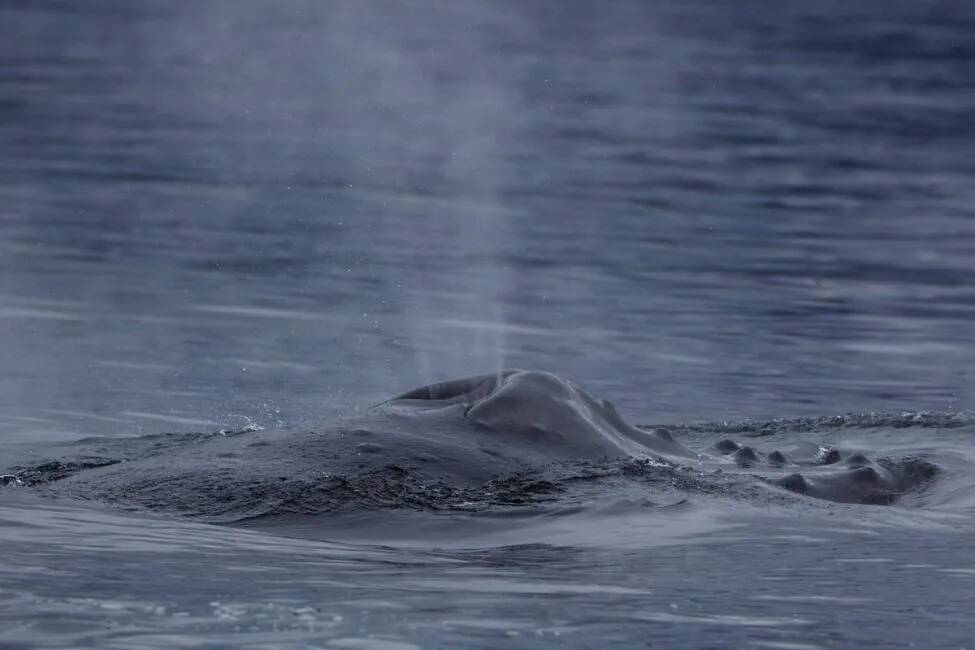
Over time, the whales’ nostrils “migrated” to the top of the head
© Igor Bobyr
Top 10 Whale Facts: Why They’re the Most Extraordinary Creatures
- The largest animals ever to inhabit our planet are blue whales. The biggest reliably measured individual was a 33.2-meter female taken near the South Shetland Islands in 1926. The heaviest whale ever weighed had a mass of nearly 182 tons.
- Cetaceans are also record-holders when it comes to tooth length. The upper jaw tooth of male narwhals can grow up to 2.6 meters.
- Whales are the only mammals capable of diving to extreme depths. The champions are Cuvier's beaked whales — sensors attached to one of them recorded a depth of 2,992 meters.
- No other mammal can hold its breath as long as a whale. The longest dive ever recorded was made by a beaked whale tracked by scientists from Duke University (USA), which stayed underwater for 3 hours and 42 minutes.
- Cetaceans are also among the longest-lived animals on Earth. Researchers once examined a harvested bowhead whale and, using amino acid analysis, determined that the male was 211 years old.
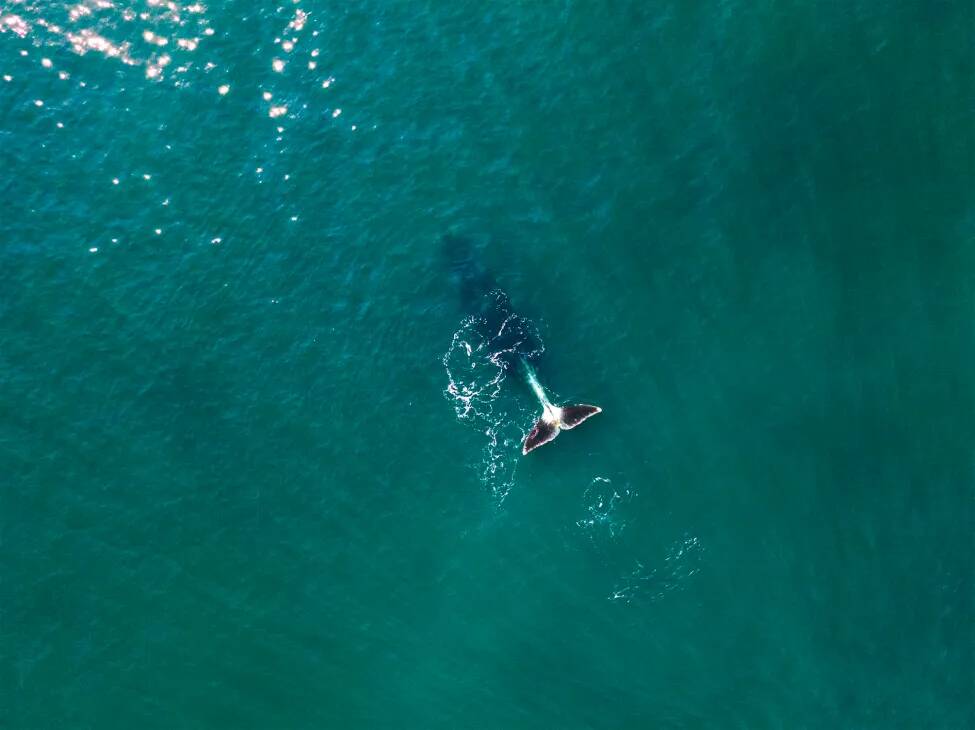
The pattern on a humpback whale’s tail flukes is unique to each individual
From the RussiaDiscovery archive
- A blue whale’s heart weighs around 600 kilograms — about as much as a small car — and can pump up to 10 tons of blood.
- Whales use sound waves to locate prey. Sperm whale clicks are the loudest sounds produced by any animal, reaching up to 230 decibels — louder than a jet engine.
- The pattern on a humpback whale’s tail flukes is unique to each individual, just like a human fingerprint. Scientists use these markings to identify whales.
- Whales also have cultural traditions. For example, different groups of orcas use distinct vocalizations and hunting techniques that are passed down from generation to generation.
- Whales are capable of interspecies cooperation. In some regions, they have been observed protecting other marine animals — such as seals — from orca attacks.
Classification of Whales
As of 2025, there are about 90–100 species of cetaceans living on Earth. Some of them are extremely rare. For example, the vaquita porpoise, found in Mexico’s Gulf of California, is on the brink of extinction — according to the latest scientific estimates, fewer than 10 individuals remain on the planet.
It is difficult for scientists to determine the exact number of whale species because of their lifestyle, deep-sea habitat, and long migrations. Many species, such as Longman’s beaked whale, are known only from remains.
One of the biggest recent discoveries in the whale world is the first thorough study of the spade-toothed whale’s body. This is the rarest whale species on Earth: only seven individuals have ever been documented. In 2024, the animal's body was discovered on a New Zealand beach.
All cetaceans are divided into two major groups: toothed whales and baleen whales. As their name suggests, toothed whales have teeth, although in some species they may be underdeveloped. Most toothed whales have elongated jaws that form a beak-like rostrum (think of a dolphin’s snout), topped with a rounded “forehead” with a fat pad. All toothed whales have a single blowhole — the two nasal passages merge into one opening. There are around 70 species of toothed whales, generally small or medium in size. But there are giants in this group as well: for example, male sperm whales can grow up to 20 meters long.
Baleen whales are generally larger than toothed whales. The largest living mammal — the blue whale — belongs to this group. Baleen whales develop teeth only as tiny buds in the embryo; later, these are replaced by baleen plates. Baleen is made up of rows of keratin plates hanging from both sides of the upper jaw. Whales filter water through these plates, trapping plankton and small fish on the fringed inner edges, then licking the catch off with their tongues. Unlike toothed whales, baleen whales have two separate nostrils, and their blowhole consists of two openings.
Blue Whale
The largest mammal on Earth feeds, like all baleen whales, on tiny marine organisms: krill and small fish. After the invention of the harpoon gun, its enormous size made it the most coveted target for whalers. Today, blue whale numbers are slowly recovering, but spotting them in Russian waters is still extremely rare.
In recent years, a few individuals have been seen in summer off the eastern coast of Kamchatka. However, acoustic monitoring shows that blue whales remain in these waters year-round. So if you charter a boat for a month and cruise along the peninsula, you just might get a chance to encounter this ocean giant.
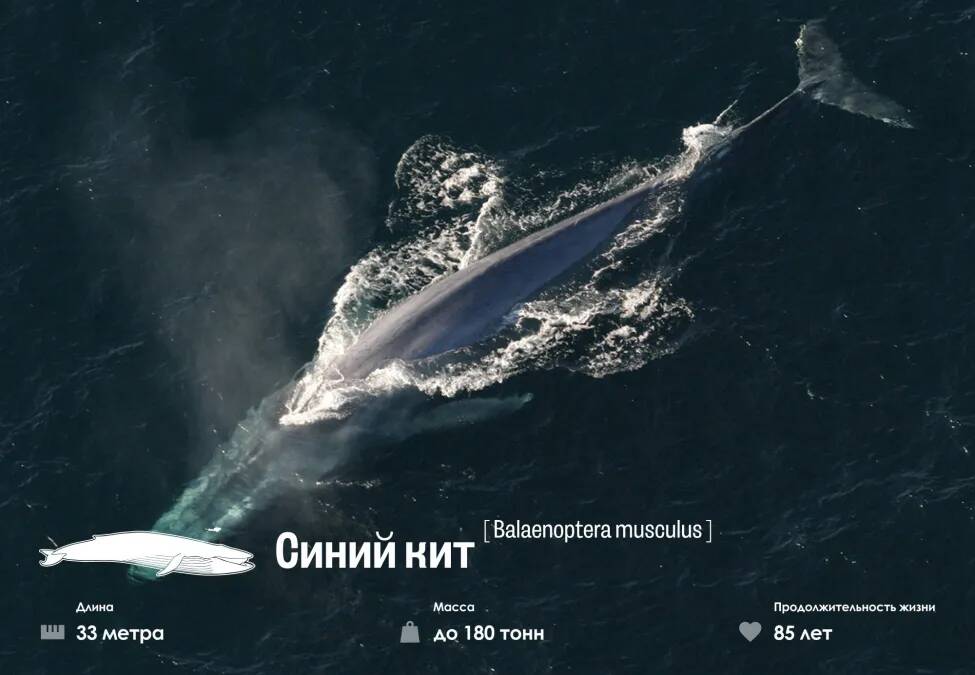
The blue whale is the largest mammal on Earth
Infographic: Andrey Sklyar
Fin Whale
The most widespread cetacean on the planet, the fin whale has mastered nearly all the world’s oceans. Like the blue whale, it was relentlessly hunted by whalers, but today it is once again regularly spotted off the coasts of Kamchatka, the Kuril Islands, and other regions of the Sea of Okhotsk.
You can easily distinguish a fin whale from a blue whale by its comparatively larger dorsal fin. And if the whale comes close, you may notice a fascinating feature of its coloration: the right side of the head is light, while the left side is dark. Fin whales often travel in pairs, so if you see two tall blows and long, smooth backs gliding at the surface, it’s very likely them.
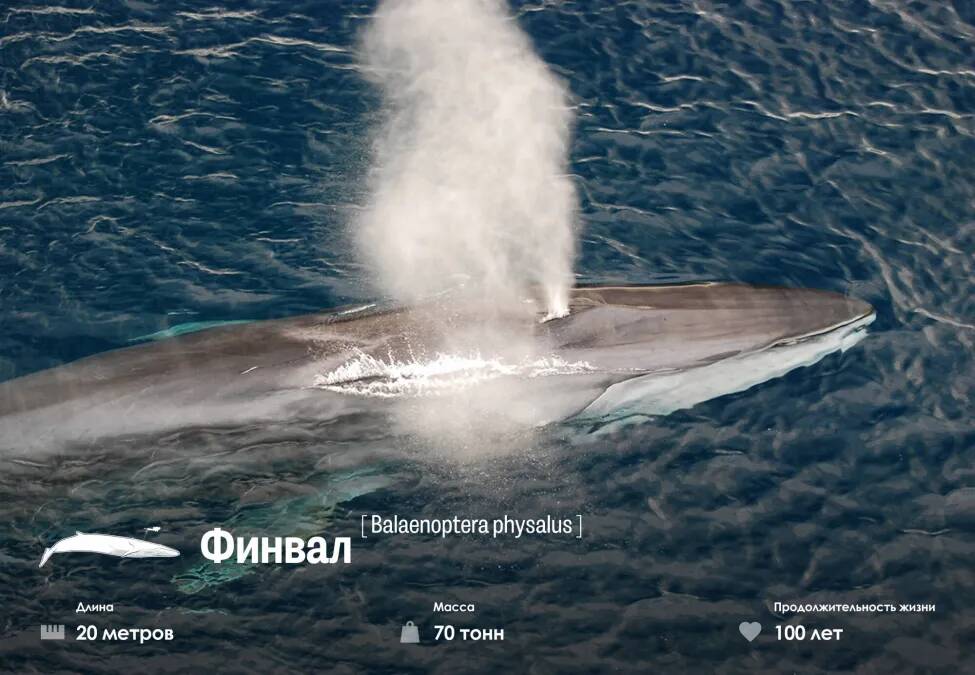
The fin whale is the most common cetacean in the world
Infographic: Andrey Sklyar
Sei Whale
Another large species — the third largest after the blue whale and the fin whale. It differs from the fin whale in the size and shape of its dorsal fin, though these are unreliable features for the untrained eye. Encounters in Russian waters are extremely rare. You are far more likely to spot a sei whale in the warm waters off the coast of Japan.
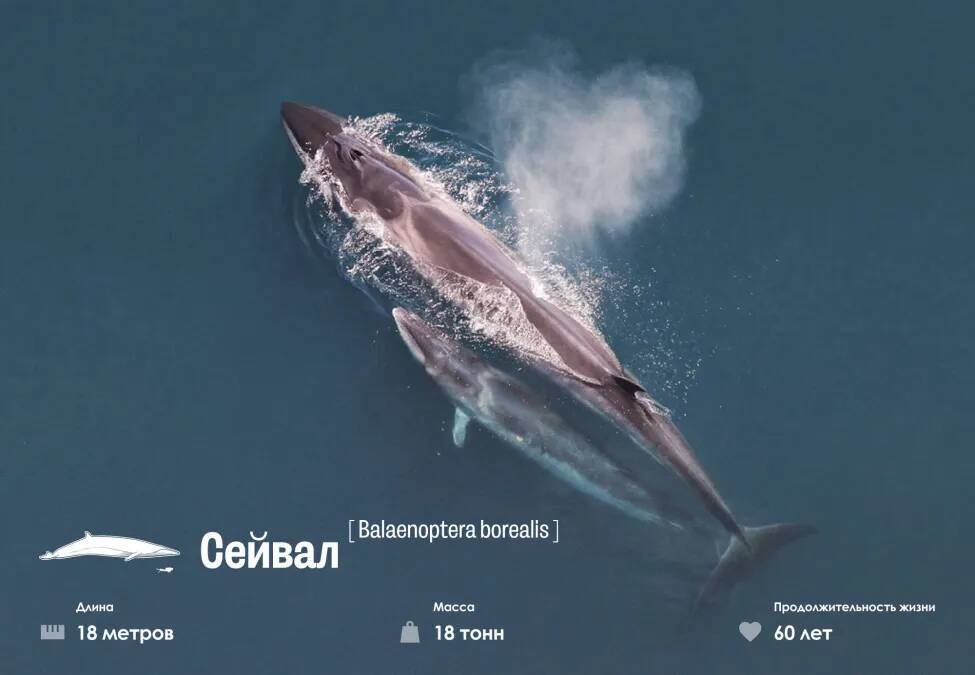
The sei whale
Infographic: Andrey Sklyar
Gray Whale
A lover of vast, shallow waters, this species' coastal lifestyle is primarily determined by its feeding habits. Unlike other baleen whales, gray whales feed on bottom-dwelling organisms. They roll onto their sides and scrape along the seafloor, sucking in sediment along with small crustaceans. Their fondness for shallow areas offers a rare opportunity to observe them from shore—sometimes just a few meters away.
Gray whales feed in the cold waters of the Pacific and are found throughout the Far Eastern seas, though their main feeding grounds lie off the coast of Chukotka. They spend the winter in warmer waters—such as the lagoons of the Baja California Peninsula—where they no longer feed but focus solely on raising their young.
The gray whale is perhaps the “dirtiest” of all whales. Its entire body is covered with clusters of barnacles that, when they fall off, leave white patches on the skin. Many areas—especially the folds—are also inhabited by whale lice and other parasites, which look like white spots as well. So despite its name, the gray whale isn’t truly gray—more like gray and speckled.
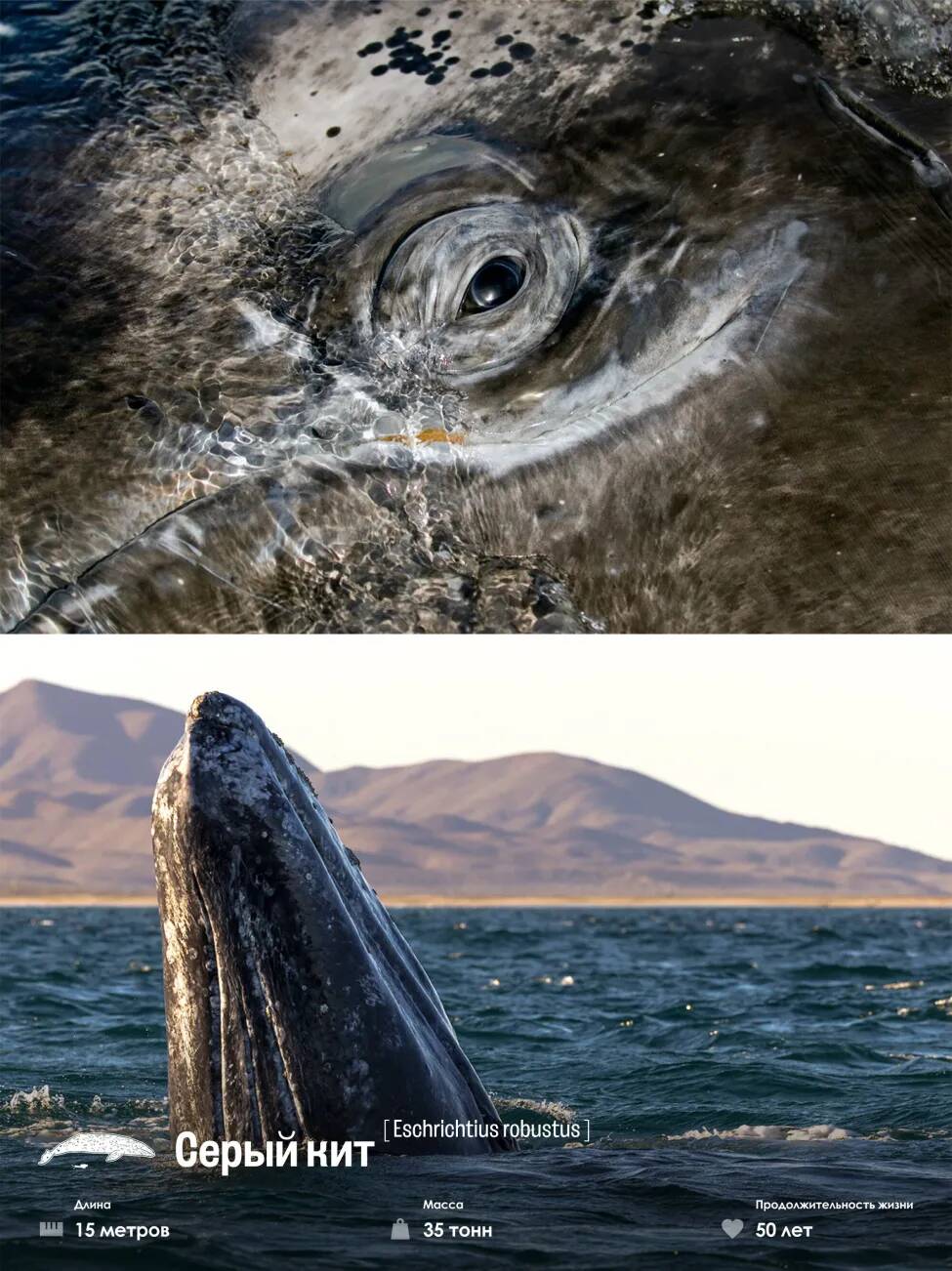
The gray whale is found in all Far Eastern seas
Infographic: Andrey Sklyar
North Pacific Right Whale
One of the rarest whales on the planet. During the height of commercial whaling, the species was almost completely wiped out, and for a time scientists believed it had vanished altogether. Eventually, however, these elusive whales began to be spotted again. There is good reason to believe that their numbers are slowly recovering. The current population is estimated at about 400 individuals in the Sea of Okhotsk and around 100 in the eastern Pacific.
You can recognize a North Pacific right whale by its deep, dark body coloration and white chin, as well as the large callosities on its head — rough, yellow-rust patches of hardened skin. These features are easy to see when the whale surfaces. It rises very sharply, almost at a right angle, so the entire front of the head appears above the water.
Encountering a North Pacific right whale is a rare stroke of luck. Your best chances are near the Commander Islands or in Chukotka, where these whales have occasionally been observed in recent years.
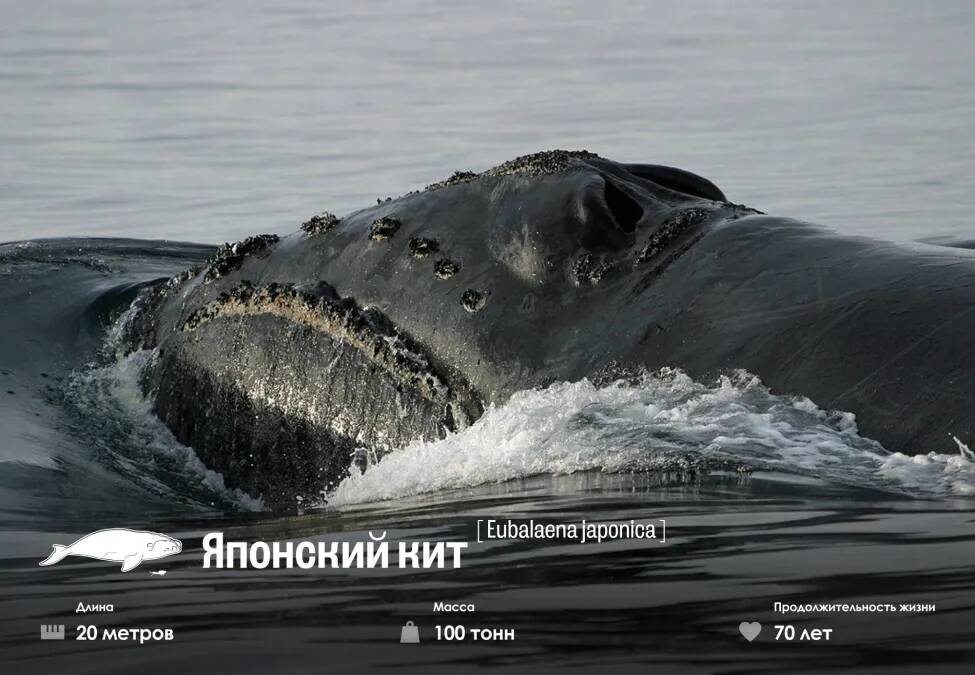
The North Pacific right whale is one of the world’s rarest cetaceans
Infographic: Andrey Sklyar
Bowhead Whale
A true resident of the Northern Hemisphere, the bowhead whale is the only whale species that spends almost its entire life along the edge of polar ice. In Russia, three populations are found: near the Bering Strait, around the Svalbard archipelago, and in the area of the Shantar Islands.
The Okhotsk (Shantar) bowheads are the smallest and southernmost population of these polar whales. They live far to the south of their Arctic relatives, in the cold waters of the Sea of Okhotsk, and do not migrate at all. Their sedentary lifestyle made them especially vulnerable to commercial whaling, and at one point they were even thought to be extinct.
Today, scientists estimate that this population numbers no more than 400 individuals. Bowheads resemble their close relatives, the North Pacific right whales, but unlike them, they lack callosities on the head and almost never lift their tail when diving.
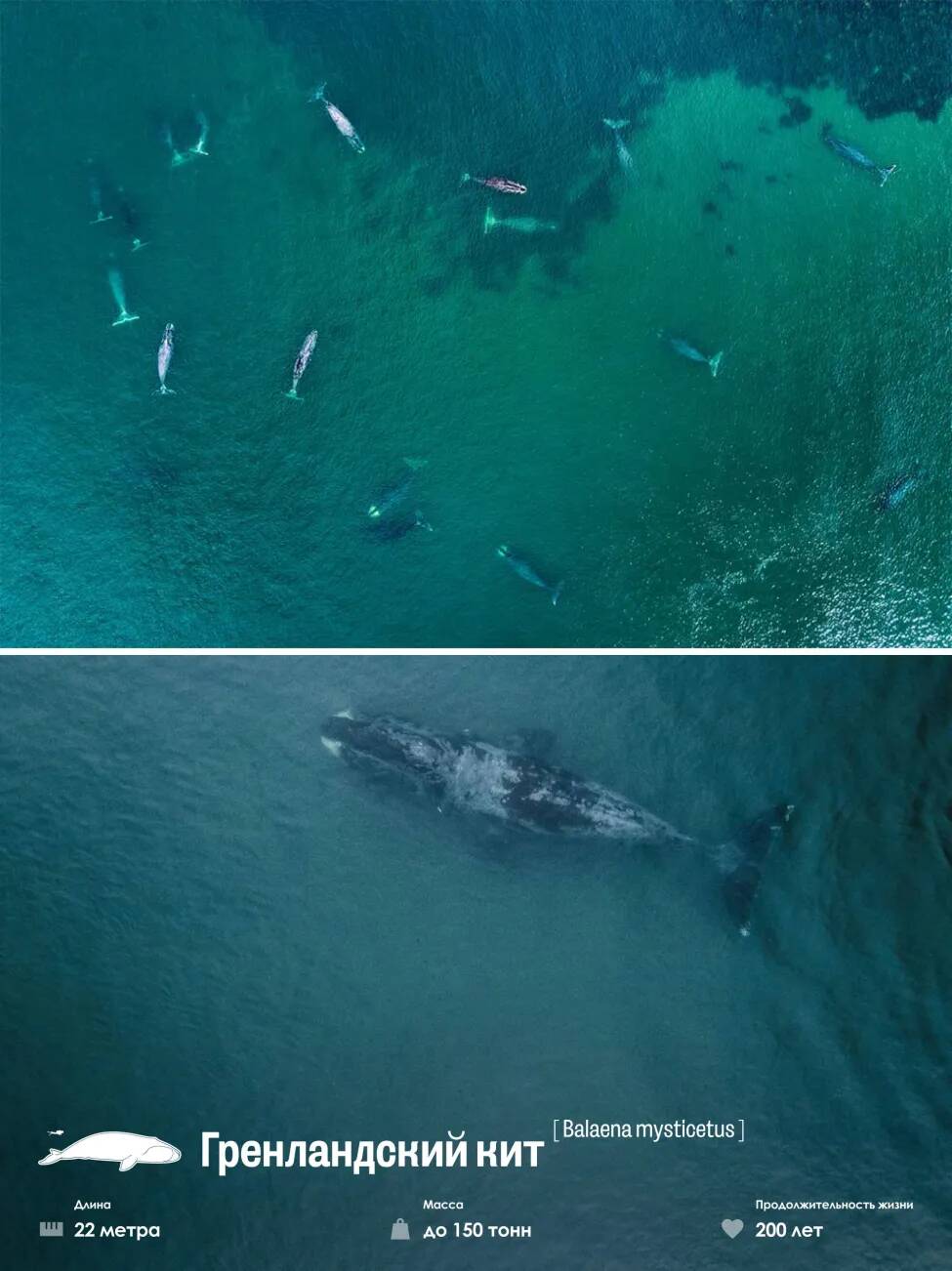
Bowhead whales can live for more than 200 years
Infographic: Andrey Sklyar
Spotting whales from the northern populations is quite difficult — they spend almost all their time along the edge of the pack ice. But the bowheads from the Okhotsk population can very likely be seen on our expedition to the Shantar Islands.
Minke Whale
The most numerous of all baleen whales, with several tens of thousands of individuals. Despite this, the minke whale is not the best species for whale-watching. It produces almost no visible blow, surfaces quickly 2–3 times to show a small part of its back, and then disappears. However, minke whales feeding is a spectacular sight. When they find a dense patch of krill, the whales gather in a group and burst to the surface with their mouths wide open.
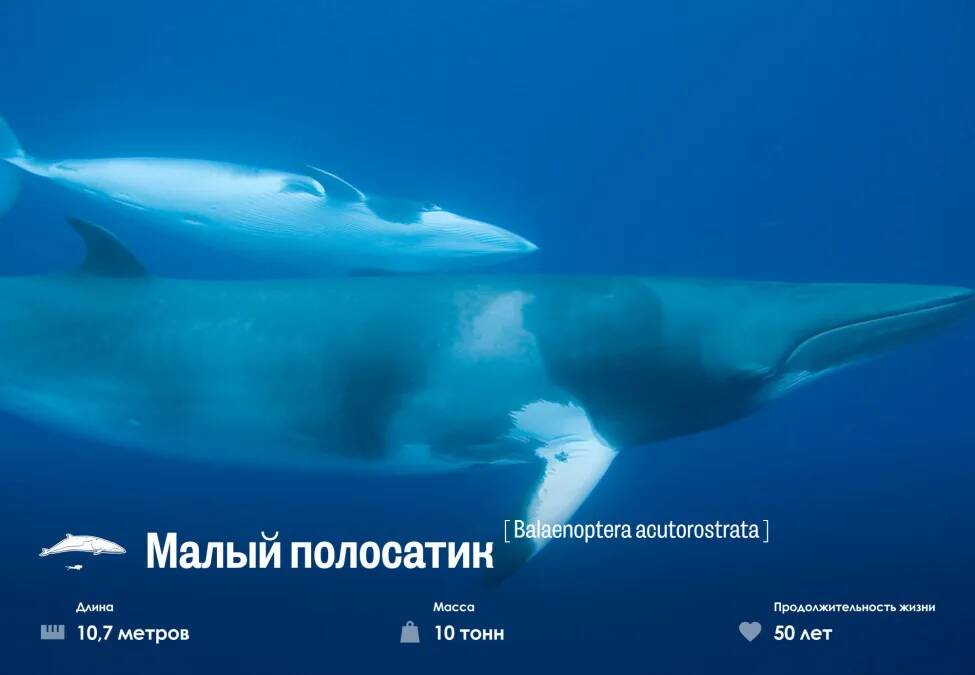
Minke whales produce almost no visible blow
Infographic: Andrey Sklyar
Humpback Whale
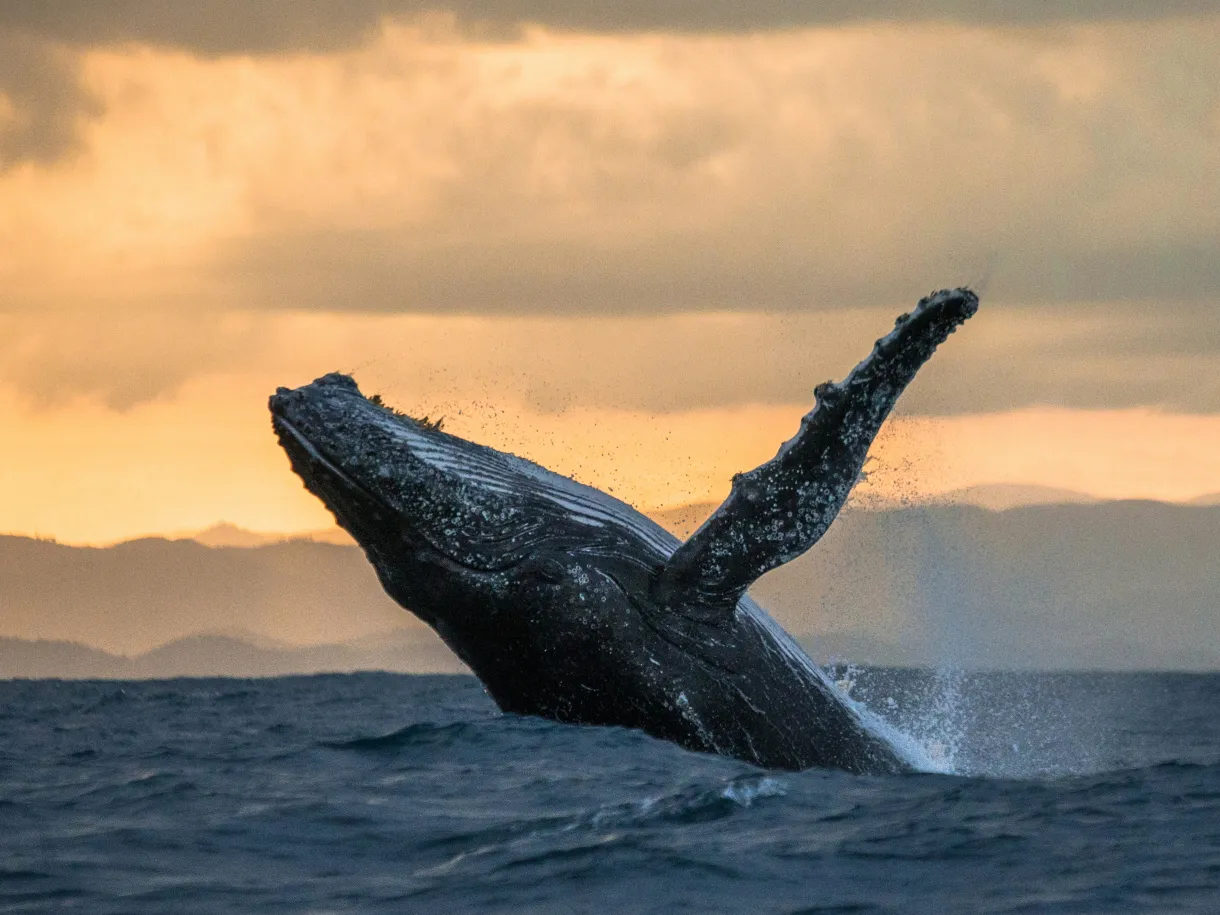
Perhaps the most famous of the baleen whales — thanks to their spectacular breaching. A 30-ton body launches completely out of the water in a halo of spray and crashes back down with a thunderous splash — a sight that leaves no one indifferent. Humpbacks are the most acrobatic of all whales and breach more often than any other species. The true purpose of this behavior remains a mystery. They may be communicating with each other, stunning or scaring fish, removing parasites, or simply playing.
Over the years of evolution, humpbacks have developed many ingenious feeding strategies. For example, they create a “bubble net,” a wall of bubbles that encircles a school of fish. Trapped and frightened, the fish cannot break through the barrier, while the humpback dives up from below and engulfs the entire school. Humpbacks also hunt cooperatively — when they strike in perfect synchrony, their chances of success increase.
Besides arching deeply when they dive — the behavior that gave them their name — humpbacks almost always raise their tail flukes, revealing an individual and often striking pattern. So when watching humpbacks, keep your camera ready: even if they don’t breach, they will almost certainly show you a beautiful “butterfly.”
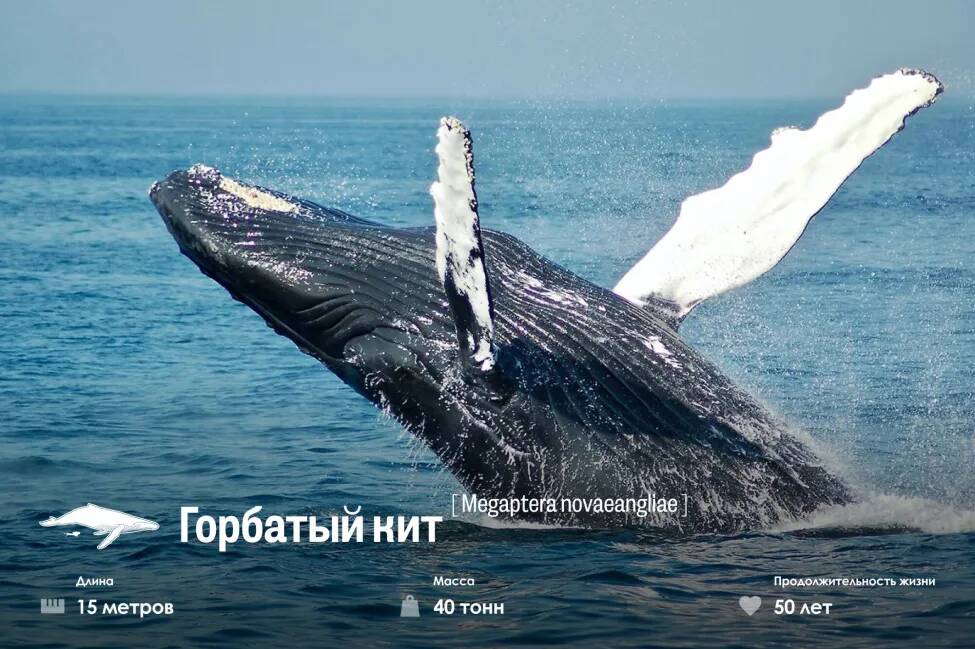
Humpbacks are the most acrobatic whales
Infographic: Andrey Sklyar
Sperm Whale
Despite their size, disproportionately large heads, and powerful teeth, sperm whales are nothing like the terrifying predators depicted in Moby-Dick. One fascinating feature of their behavior is that males and females never stay together except during the breeding season. After mating, the males immediately head for colder waters, where they spend the entire year. This is why in Russia you almost always encounter only males — and mostly solitary ones.
Females, on the other hand, live in warmer waters and stay in large groups. This social lifestyle is an effective strategy for raising calves. While a mother dives deep to feed, her young — still unable to make such descents — waits not alone but in the company of other females.
Sperm whales feed on deep-water squid, diving after them to great depths and for long periods. When they resurface, they need a lot of time to catch their breath. This is your best chance to get a good look at a sperm whale: before diving again, it takes up to a hundred powerful breaths, a process that lasts several minutes. Sperm whales prefer areas with steep underwater drop-offs, which is why they are most often seen around the Kuril Islands and eastern Kamchatka.
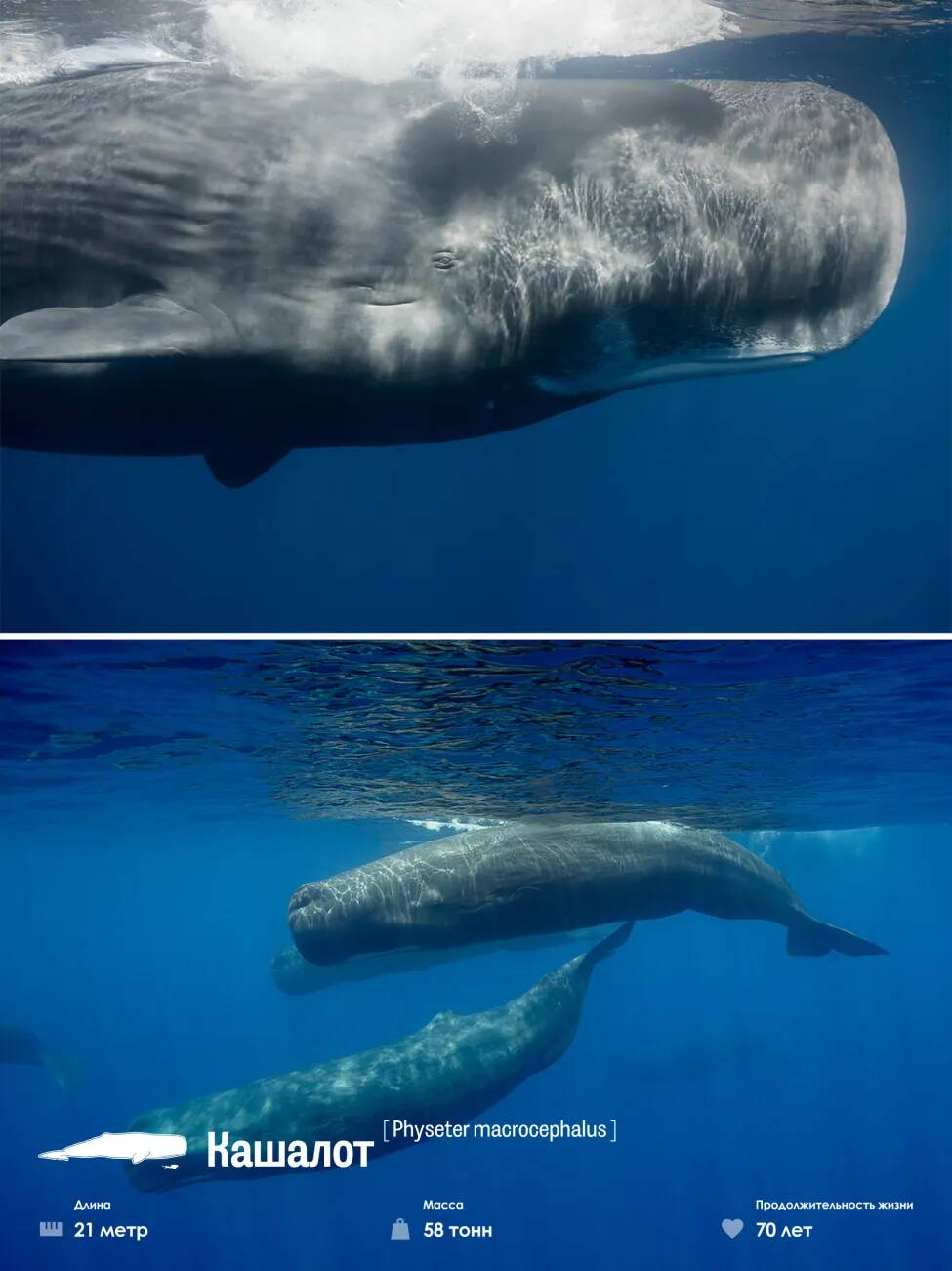
Sperm whales are most often spotted in the Kurils and Kamchatka
Infographic: Andrey Sklyar
Narwhal
A dolphin often called the “unicorn of the sea.” Of course, it doesn’t have a horn — but all males grow a long tusk, which is actually an elongated tooth on the left side of the upper jaw. Scientists still haven’t determined exactly what role this tusk plays in narwhal life. Several hypotheses exist, and the most plausible suggests it is simply a secondary sexual characteristic, much like the bright breeding plumage seen in some male birds.
In Russian waters, the best place to encounter narwhals is along the shores of the Franz Josef Land archipelago, part of the Russian Arctic National Park.
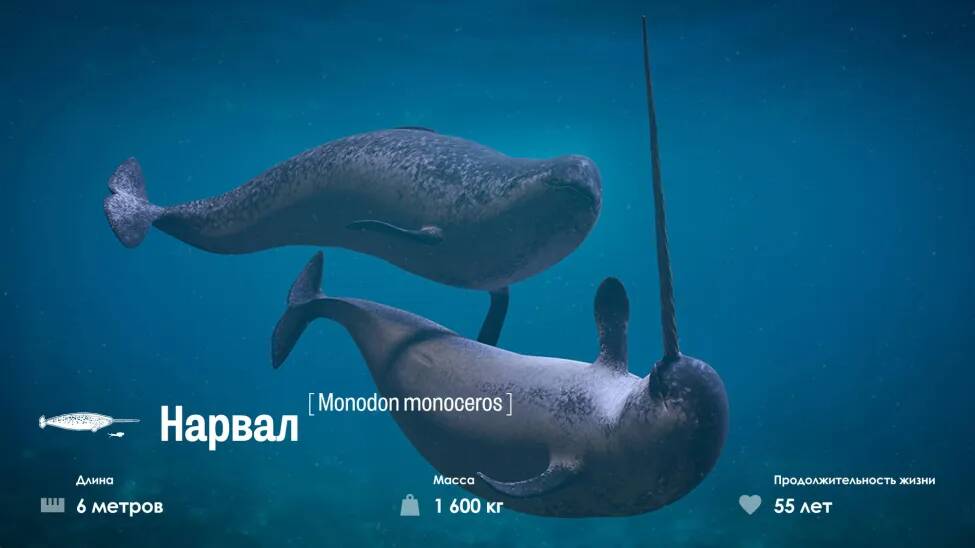
Narwhal — the unicorn of the sea
Infographic: Andrey Sklyar
Beluga Whale
Belugas (also known as white whales) inhabit all the seas of the Russian Arctic, and they are almost always seen in groups or even large herds of several hundred animals. They get their name from the color of adult whales. The species is especially abundant in the Sea of Okhotsk and the White Sea.
In summer, belugas move to vast shallow areas and feed close to shore. The most famous place to observe large beluga herds — both from the water and from land — is Cape Beluzhy on Bolshoy Solovetsky Island.
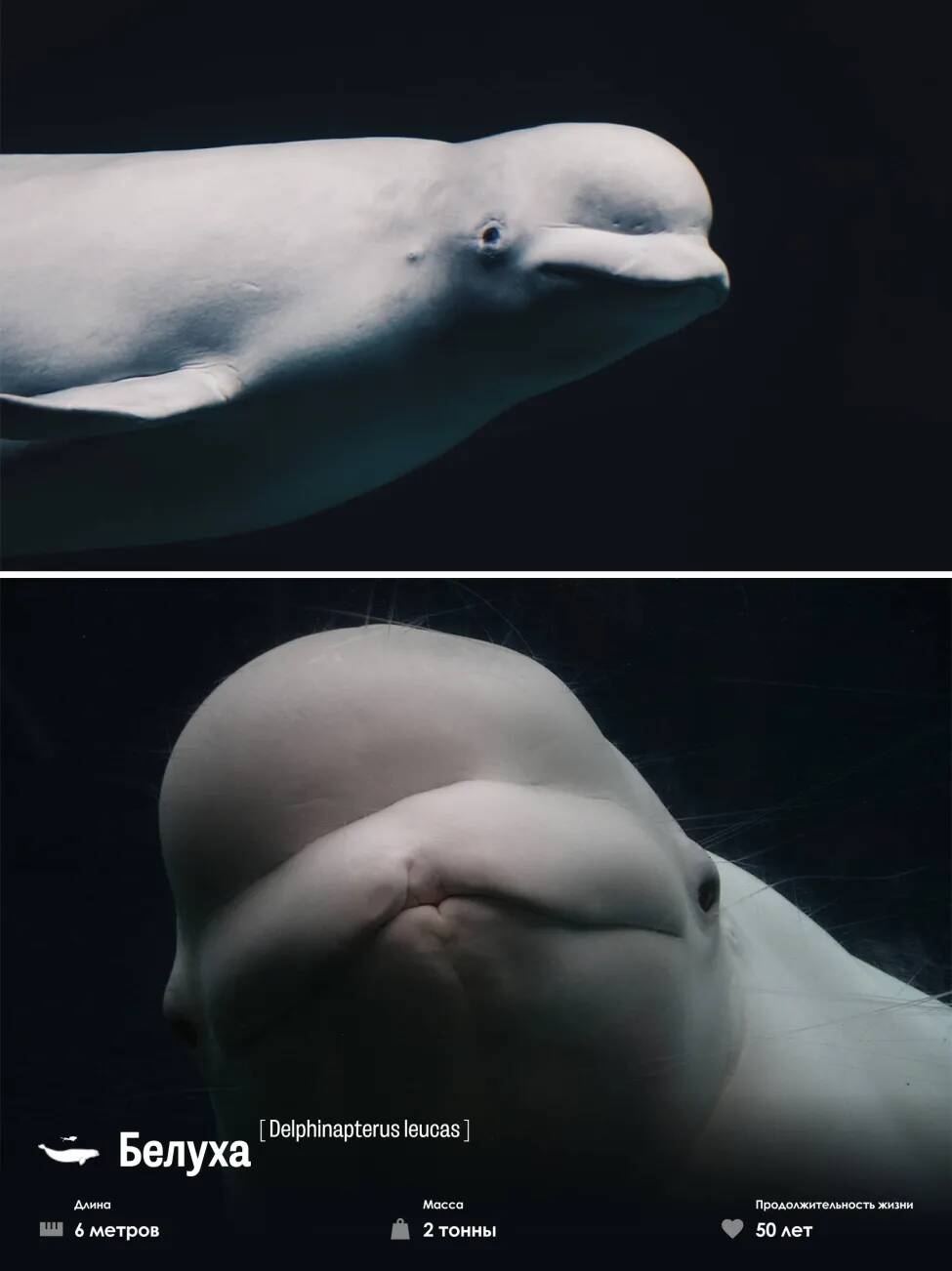
Belugas inhabit all the seas of the Russian Arctic
Infographic: Andrey Sklyar
Orca
The orca stands apart as the world’s most recognizable cetacean. We grow up seeing them in books, movies, and documentaries. Yet despite their fame, people know surprisingly little about these animals. Orcas have an undeserved reputation for ferocity, and the English name “killer whale” has inspired countless myths about how dangerous they supposedly are to humans.
For a long time it was believed — and many still think — that orcas are fearsome ocean predators that eat anything that moves: from fish to whales, and even divers. In reality, orcas are highly selective eaters, and there are actually two distinct types: fish-eating orcas, which feed exclusively on fish, and mammal-eating orcas, which do hunt mammals — but seals or other cetaceans, not humans.
Mammal-eating orcas are also far less numerous. Their Russian population is estimated at only about 500 individuals and is listed in the Red Data Book.
Orcas are found in all seas and oceans except a few enclosed seas. Mammal-eating orcas live in small groups of around three animals, while fish-eaters typically form large family pods structured around maternal lines.
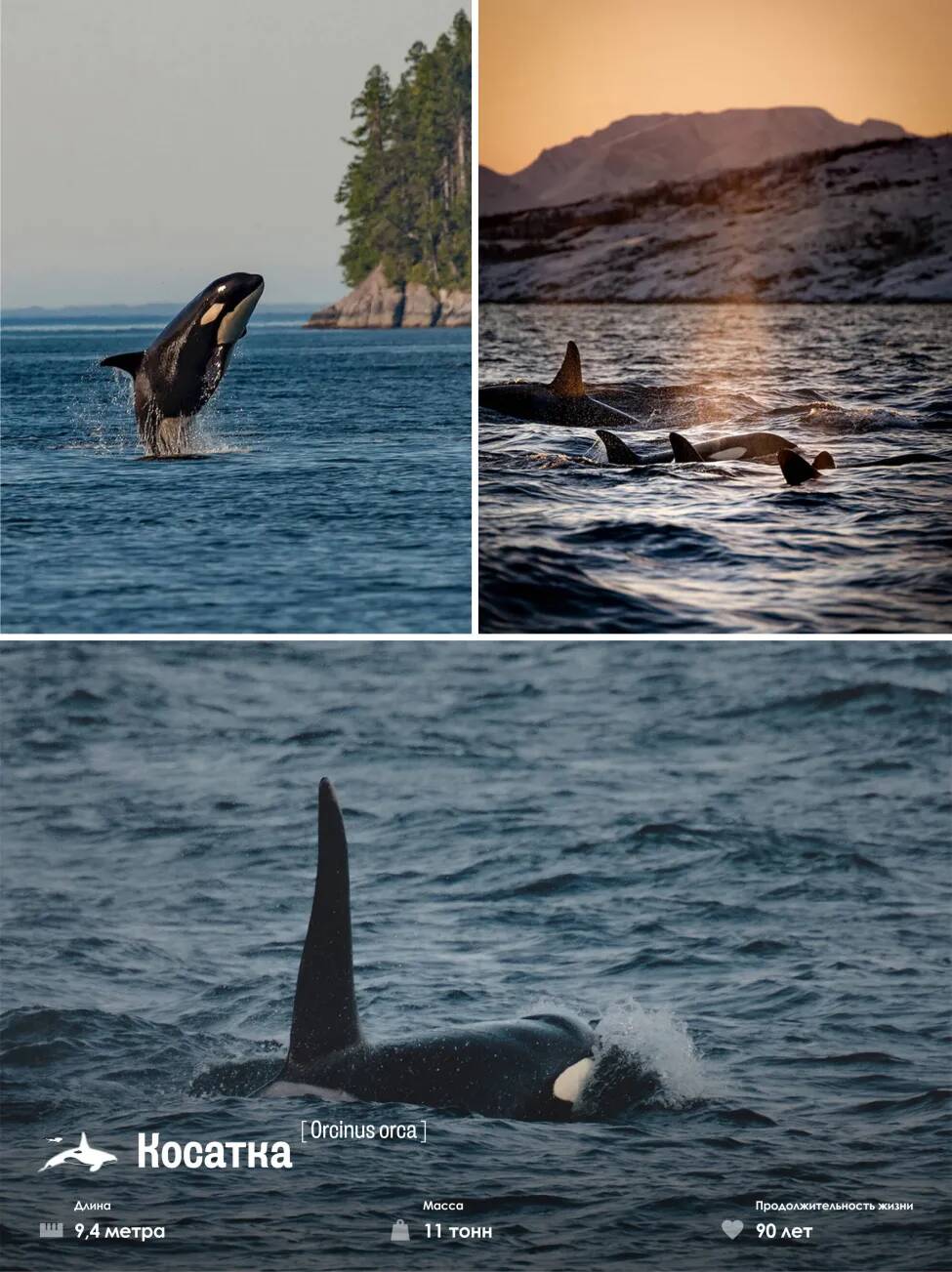
The orca is the most recognizable cetacean on the planet
Infographic: Andrey Sklyar
Whale-Watching Guidelines
It’s important to remember that whales are in their natural environment, going about their normal lives: feeding, communicating, resting, and caring for one another and their young. We are guests in their world and should avoid disturbing them. Based on many years of research, scientists have developed clear guidelines for watching whales responsibly. Following these rules ensures that you enjoy the experience without harming the animals.
So be prepared for a few restrictions:
- Boats will not enter the so-called exclusion zone (50–100 meters, depending on the species). You’ll only see a whale closer than that if the animal chooses to approach the boat on its own — which often happens if the vessel doesn’t startle it.
- Meeting whales is a thrilling experience, but try not to express your excitement too loudly. The noise of the engine already bothers the animals, and loud shouts or stomping your feet on the deck may frighten them.
- Do not try to touch marine mammals even if they come right up to the boat. First, you risk falling overboard. Second, if the whale notices sudden movement, it may flick its fin — and then everyone might end up in the water.
A Brief History of Human–Whale Relations
Since ancient times, people’s attitudes toward whales have followed two paths.
The first was religious and mythological — and therefore respectful or fearful. Whales were revered creatures for many cultures, and sailors attributed monstrous powers to them, including the ability to swallow ships.
The second path was utilitarian: marine mammals were viewed purely as a resource. Whale meat was an everyday food in Scandinavia and coastal parts of Asia as recently as the mid-20th century. And in the early 1900s, the street lamps of Europe burned whale oil.
Commercial whaling wiped out several whale species entirely and drove many populations to catastrophically low numbers — levels from which some still have not recovered, even decades after the whaling moratorium of 1986.
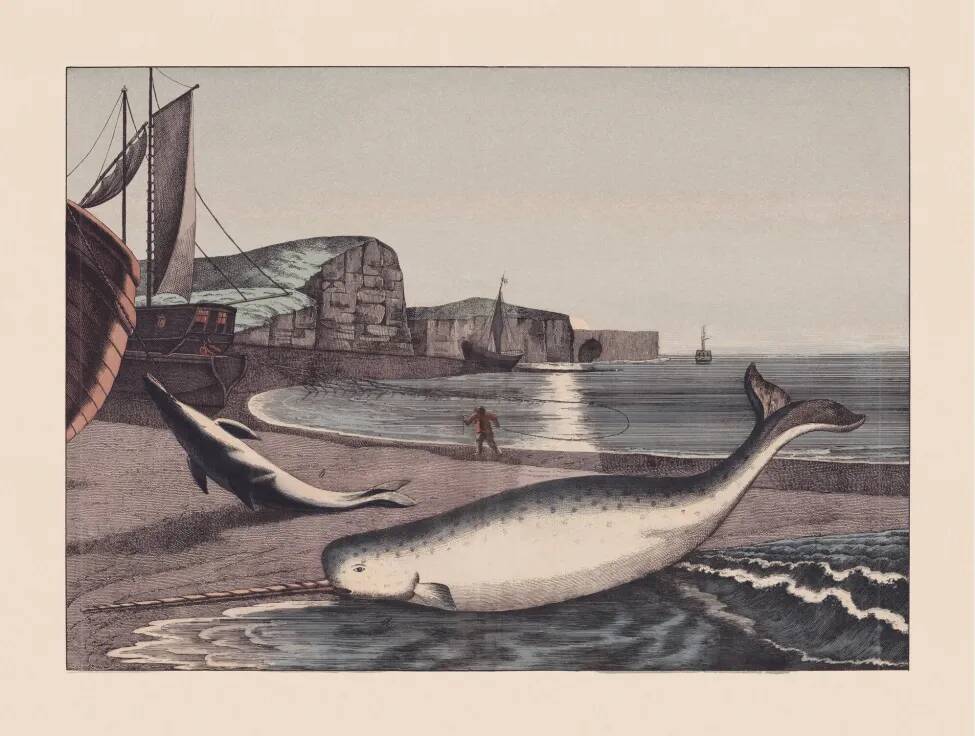
Chromolithograph, 19th century
© iStock
The intertwining of these two attitudes — spiritual reverence and practical use — can be found only in the culture of the coastal peoples of the Far North, the Inuit. For them, the whale was not only a vital source of meat, blubber, and bones for building shelters, but also a sacred creature at the heart of their animistic beliefs.
Where to See Whales in Russia
The Commander Islands
The islands and the surrounding 30-mile coastal waters are part of the Commander Islands National Park, protected by the state for good reason. These rocky, ocean-lost islands, devoid of trees, are home to tens of thousands of seals and seabirds. And the cold waters around the archipelago attract hundreds of cetaceans from 22 species.
However, a trip to the Commanders is often complicated by unpredictable weather. Just a couple of hundred kilometers away lies a low-pressure zone that generates cyclones over the Pacific Ocean. As a result, suitable whale-watching weather may not appear for weeks.
The Shantar Islands
This archipelago spreads across the western part of the Sea of Okhotsk. The largest island, Bolshoy Shantar, covers an area bigger than St. Petersburg, while the smallest are sheer, inaccessible cliffs. The Shantars are unique not only for their diverse landscapes, unusual island vegetation, and fogs, but also because the waters around them are home to the southernmost population of bowhead whales. You’re very likely to see them on our expedition.
The Kola Peninsula
Lichen-covered mountains, impassable bogs, crystal-clear lakes and rivers, endless tundra, and deep northern taiga — all this awaits on the Kola Peninsula, just a 2.5-hour flight from Moscow. Adding to the region’s harsh yet striking beauty is the Barents Sea, which never freezes in winter and is rich in fish. Minke whales, humpbacks, and orcas come here to feed.
Wrangel and Herald Islands
These two Arctic islands were discovered only in the mid-19th century, and even today the sea ice that grips the archipelago — sometimes even in summer — often blocks the way for travelers. Reaching them is possible only aboard a specially equipped vessel.
The islands are best known as a major “maternity ward” for several hundred polar bears. But the waters of the Chukchi Sea also offer whale encounters: bowheads, humpbacks, orcas, and belugas often feed or migrate near these ice-shrouded islands.
Kamchatka
Sharp peaks of active volcanoes, flowing and frozen lava fields, bubbling geysers, salmon-filled rivers, and forests where bears reign supreme — this is the Kamchatka Peninsula, a place everyone should see at least once in their lifetime. Kamchatka is not only the land of volcanoes but also the land of the Pacific Ocean — which means whales and dolphins. For example, orcas can be observed not far from the regional capital. Large numbers of fish-eating orcas feed on greenling at the entrance to Avacha Bay, making sightings virtually guaranteed when the weather is favorable.
Chukotka
Standing at the eastern edge of Eurasia among wind-carved cliffs plunging into the ocean, a bold traveler will truly feel how harsh — and at the same time fragile — northern nature can be. Nowhere else but here can you see vast seabird colonies, thousands of walruses, hundreds of seals, and dozens of whales of various species — all in a single day — and then watch the northern lights once the sun slips below the horizon.
Franz Josef Land
The northernmost archipelago of Eurasia — beyond it lie only hundreds of kilometers of water and ice before the Pole. Much of Franz Josef Land’s history is tied to early attempts to reach the North Pole. Here you can touch the artifacts that reveal the secrets of the Arctic and feel like a true pioneer. These icy waters are also patrolled by the mysterious “unicorns of the sea” — narwhals — and encounters with bowhead whales are possible as well.
The Solovetsky Islands
The world-famous monastery is just one of the archipelago’s many unique landmarks. Solovki attract not only those interested in its rich historical and cultural heritage but also lovers of northern nature. Here you can watch belugas right from the shore or take a boat trip to see them up close from the water.
When to Spot Whales
The best time to observe cetaceans in Russia is during their feeding season, when whales arrive in cold waters to bulk up for the year. You can’t go wrong planning a trip between July and September.
Seasonal whale migration is also an unforgettable spectacle — especially around the Commander and Kuril Islands, when the blows of dozens of humpbacks or fin whales erupt along the horizon. But predicting the exact moment of this “whale boom” isn’t always possible, as their movements depend on many natural factors.
Can You Take Kids on Whale Trips?
For most children, their first encounter with cetaceans happens at an oceanarium. Unlike zoos — which often function as genetic-reserve banks, research centers, and places where rare species are conserved — oceanariums are purely commercial enterprises. Marine mammals cannot live normally in cramped enclosures. A wild adult orca, for example, may travel up to 150 kilometers a day. In captivity, animals are fed unnatural diets (fish-eating orcas are given dead fish), trained with inhumane methods to perform tricks and unnatural movements in shows, and — most importantly — separated from their families, even though social bonds are crucial to them. During captures, relatives trying to defend the animal are often killed. Naturally, after all this, the captives frequently become ill and die prematurely. With this in mind, it’s only natural not to want to bring a child to a dolphin show.
Whale-watching trips are not just an alternative — they are the only truly ethical way to glimpse the secrets of the whale world and share that experience with your children. Some Far Eastern and Arctic expeditions are better suited to teenagers, who can more easily handle harsh weather and long sea passages. But in warm-water destinations, even a three-year-old can enjoy watching whales.
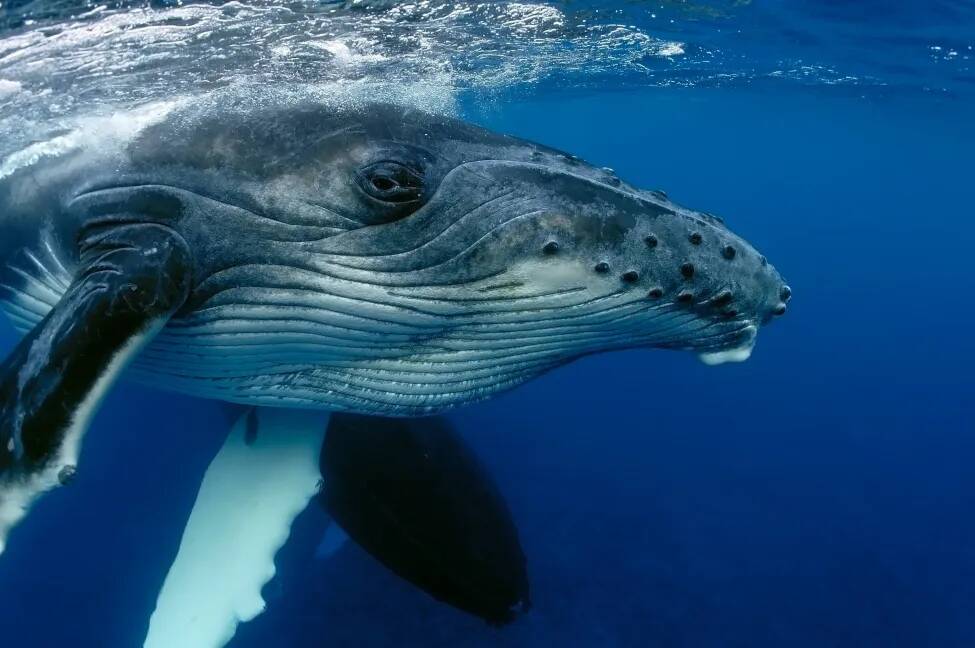
Humpback whale
© iStock
How to Photograph Whales
Any traveler who sees a whale naturally wants to bring home a memorable photo of the ocean giant. Because of the rules regulating how close you can approach marine mammals, it’s best to have a telephoto lens — 300 mm is usually enough to get an excellent shot. Keep your camera at the ready and protect it from spray.
Many whales surface and dive quickly. When you start noticing signs that a whale is rising — bubbles, ripples, or the animal appearing just below the surface — get your camera ready. You’ll only have a few seconds to press the shutter.
After a series of breaths, most whales dive deeper. To do this, they arch their bodies, point their heads downward, and lift their tail flukes high above the water. Be prepared to capture this spectacular moment. Even if you’re not a professional photographer, switch your camera to shutter-priority mode and set it to at least 1/1000 — this minimizes the chance of motion blur.
Sometimes, however, you can get fantastic photos with just a smartphone — or even take a selfie with a whale. For example, during humpback-whale feeding in the Senyavin Strait in Chukotka (part of the Beringia National Park), groups of several dozen whales often gather in one area. In this protected marine zone they are undisturbed, so humpbacks behave calmly around boats and may come very close as they go about their whale business — perfect for a selfie, or at least a full-frame smartphone shot.
How Marine Giants Are Being Protected in 2025
- Since 2022, the capture of whales for commercial sale has been banned in Russia, and since 2024 — for educational and cultural purposes as well .
- Russia cooperates with the International Whaling Commission.
- The country operates the Whale Protection Fund, an organization that opposes the mass killing of whales and fights marine pollution.
- In 2024, the Ministry of Natural Resources approved a conservation plan for two endangered species — the gray whale and the bowhead whale. This means the state will give these species special attention.
- Since 1995, the nationwide Russian Gray Whale Project has been monitoring the population of gray whales that migrate to Sakhalin’s shores with their calves to feed and build up fat reserves before the harsh season. Volunteers record where the whales are encountered, track their fat accumulation, and monitor population numbers.
Whale-Watching Prep List: Books and Films
- “Spying on Whales” — If you’d like to learn more about the largest animals ever to live on Earth, their evolution, and their future before setting off to see them in the wild, this book by paleontologist and marine biologist Nick Pyenson is an excellent place to start.
- “Cloudy with a Chance of Killer Whales” — A book by one of Russia’s leading whale experts, Olga Filatova, about the mysterious lives of orcas and other cetaceans in Russian waters. After reading it, you’ll be even more inspired to see these animals in their natural environment.
- “Whales and Dolphins” — Another book by Olga Filatova, focused primarily on the species found in Russian seas. Written in a “simple explanations for complex things” style, it offers an accessible look into the world of marine giants.
- “Where and When You Can See Whales” — A lecture by renowned marine-mammal specialist Grigory Tsidulko. A polar guide and researcher with more than 30 expeditions studying marine wildlife, he shares engaging insights on whales and where to find them.
- “The Book of the Sea” — A film about the traditional sea hunters of Chukotka, where the real stories of modern coastal communities intertwine with ancient legends and myths. Documentary footage is blended with atmospheric animation. The film is in Chukchi and Eskimo languages with subtitles.
Whale-Watching Around the World
Cetaceans live in all the world’s oceans, except for a few enclosed seas. For example, you can spot orcas and humpbacks in the shining landscapes of Antarctica. Bowhead whales and narwhals appear in the icy waters of the Arctic Ocean. In autumn and winter, vast herring schools gather off the coasts of Norway and Iceland, drawing large numbers of whales — especially orcas and humpbacks.
Sperm-whale females and calves, as well as blue whales, are most often seen in the warm waters of the Atlantic. If you visit the Azores in May or June, you can also witness the migration of more than a dozen cetacean species. From September to December, North Pacific right whale arrive with their calves at Argentina’s Valdés Peninsula, along with many other species — this is one of the Atlantic’s most famous whale-watching destinations. You can also spot fin whales and several dolphin species in the Bay of Biscay off the coast of Spain in August and September.
The Indian Ocean also offers numerous whale-watching locations. Nearly 40 species of whales and dolphins inhabit the waters off East Africa and around Sri Lanka. Travellers most often encounter sperm whales, humpbacks, and blue whales. And if you don’t want to plan around seasons, remember New Zealand: off the South Island, whale watching is possible year-round.
Explore our trips to Russia’s best whale-watching destinations — choose an expedition to the Shantar Islands, Chukotka, or any other route that inspires you. If you have any questions, call us at +7 (495) 104-64-36 or email us at hello@russiadiscovery.ru. We’ll be happy to assist you.
Contributors
Igor Bobyr
Author
Ira Moskvitina
Editor
Yuliya Kopyltsova
Editor
Ezhena Bykova
Proofreader
Maria Potapova
Translator
Notice an error or inaccuracy?
Write to usSee also
All articles